














Glossary of elastomer processing
Shore hardness
Shore hardness is a measure of the hardness of materials such as elastomers (rubber) and plastics. It describes a material's resistance to the penetration of an indenter under standardised conditions. Shore hardness is measured on different scales, which vary according to material type and application. The scales range from Shore A for soft materials to Shore D for harder materials.
For the elastomers we use, we start in the very soft range at 25° Shore A, followed by the standard hardnesses of 50 to 65° Shore A, up to the hardest materials (hard rubber) in the range up to 90° Shore A. The tolerances here are usually ±5° Shore.
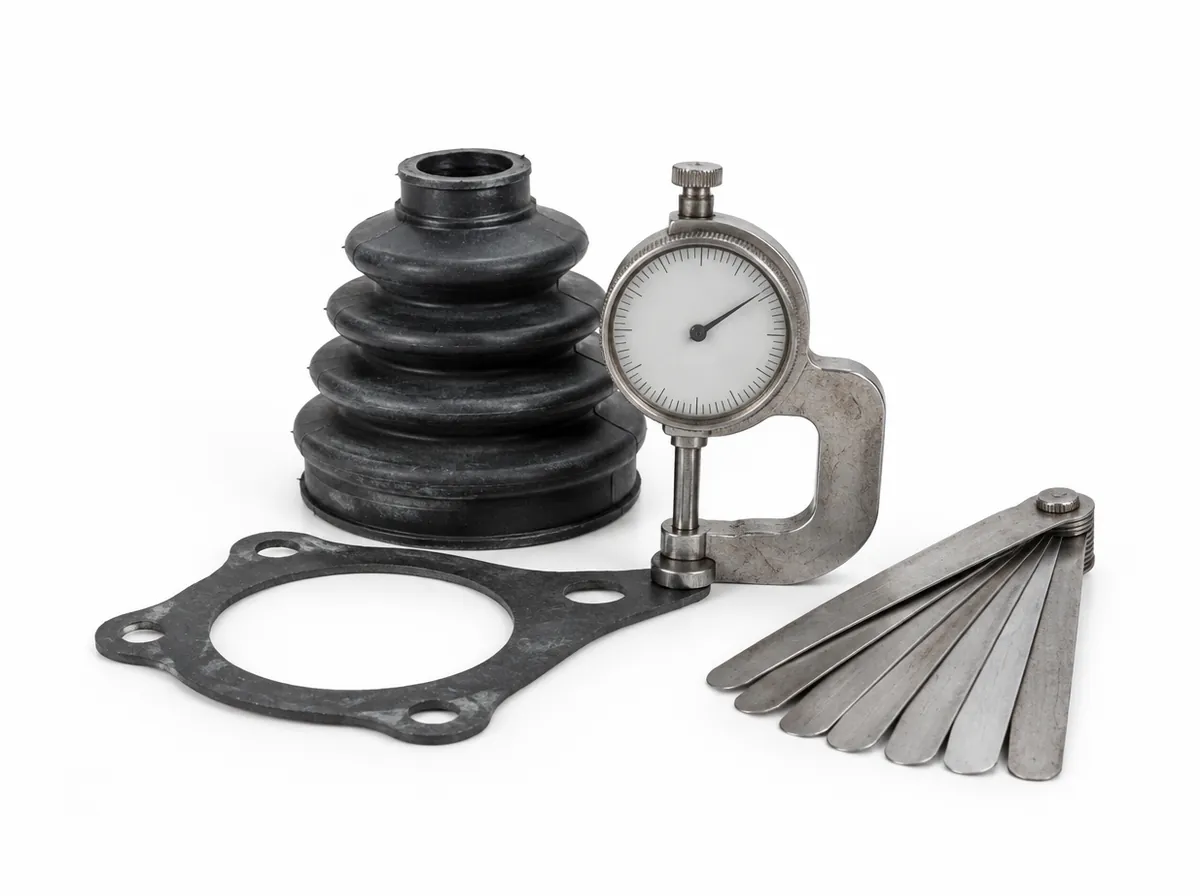
Shore hardness is measured with a durometer. This instrument presses a standardised indenter (pin or needle) onto the material surface with a defined force. The penetration depth of the indenter is stated in Shore units (0 to 100), where:
-
0 Shore: maximum penetration depth (very soft material).
-
100 Shore: no penetration (very hard material).
Measuring procedure
-
Test conditions: standardised temperature and time for precise results.
-
Measuring time: Shore hardness is usually read after 3 seconds.
There are several scales, used depending on the material type and application:
| Scale | Material type | Examples |
|---|---|---|
| Shore A | Soft materials | Rubber, elastomers, TPE, flexible PVC, soft plastics |
| Shore D | Hard materials | Hard plastics, thermoplastics, thermosets |
| Shore 00 | Very soft materials | Sponge rubber, cellular rubber, foams |
| Shore C | Medium hardness | Semi-hard types of rubber |
Shore hardness is an important parameter for evaluating the mechanical properties of a material:
-
Flexibility: soft materials (low Shore hardness) are more flexible, harder materials (high Shore hardness) more resistant.
-
Wear resistance: materials with higher Shore hardness generally show better abrasion resistance.
Shore hardness is a decisive factor in many industries:
Rubber and plastics industry
-
Seals: Shore hardness affects the sealing effect and flexibility.
-
Hoses: harder materials are more pressure-resistant, softer hoses more flexible.
Automotive industry
-
Tyres: Shore hardness determines grip and wear.
-
Shock absorbers: flexible material for better vibration damping.
Construction industry
-
Facade seals, profiles: soft sealing materials adapt to uneven surfaces.
-
Insulating materials: harder layers for protection and stability.
Medical technology
-
Silicone seals: Shore A for flexible and sterile applications.
-
Prostheses: different hardnesses for comfort and stability.
The Shore hardness of a material depends on various factors:
-
Material composition: polymer type, fillers and additives affect hardness.
-
Temperature: a material becomes softer at high temperatures and harder at low temperatures.
-
Ageing: materials can harden or become brittle over time.
Measuring Shore hardness is not always straightforward:
-
Material homogeneity: inhomogeneous materials can give inconsistent results.
-
Test conditions: fluctuations in temperature or humidity affect the measurement.
-
Specimen thickness: the thickness of the specimen must meet the requirements of the standard.
-
What is the difference between Shore A and Shore D? Shore A is used for soft materials such as rubber, while Shore D is suitable for harder materials such as hard plastics.
-
How accurate is Shore hardness measurement? The measurement is precise if the requirements of the standard for temperature, time and specimen thickness are met.
-
Can Shore hardness be changed? Yes, by adjusting the material composition or the production process.
-
Does Shore hardness indicate material quality? No, Shore hardness is only one parameter and must be considered in the context of other properties. This value has no influence whatsoever on the actual material quality.
Shore hardness is an important parameter for evaluating the mechanical properties of materials. It influences the choice of material for specific applications and plays a decisive role in product development, quality control and process optimisation. Precise measurement allows materials to be optimally matched to their applications.
Questions about this term?
Our technical advice
Do you have a specific application or a question about elastomer processing? Talk to us, we will help you with material, process and approval.