





1. Overview of relevant standards
Flat seals must meet a wide range of norms and standards, which differ depending on the industry and application. The most important include:
-
DIN EN 1514: Requirements for gaskets for flange connections.
-
DIN EN 12560: Standards for flat seals in the petrochemical industry.
-
ASME B16.21: Standards for flat seals in piping systems.
-
KTW-BWGL, DVGW and W270: Requirements for use in drinking water applications.
-
FDA, BfR and EC 1935/2004: Requirements for seals in contact with food.
-
UL94 and other fire protection classes: Requirements for burning behaviour.
2. DIN EN 1514: Flat seals for flange connections
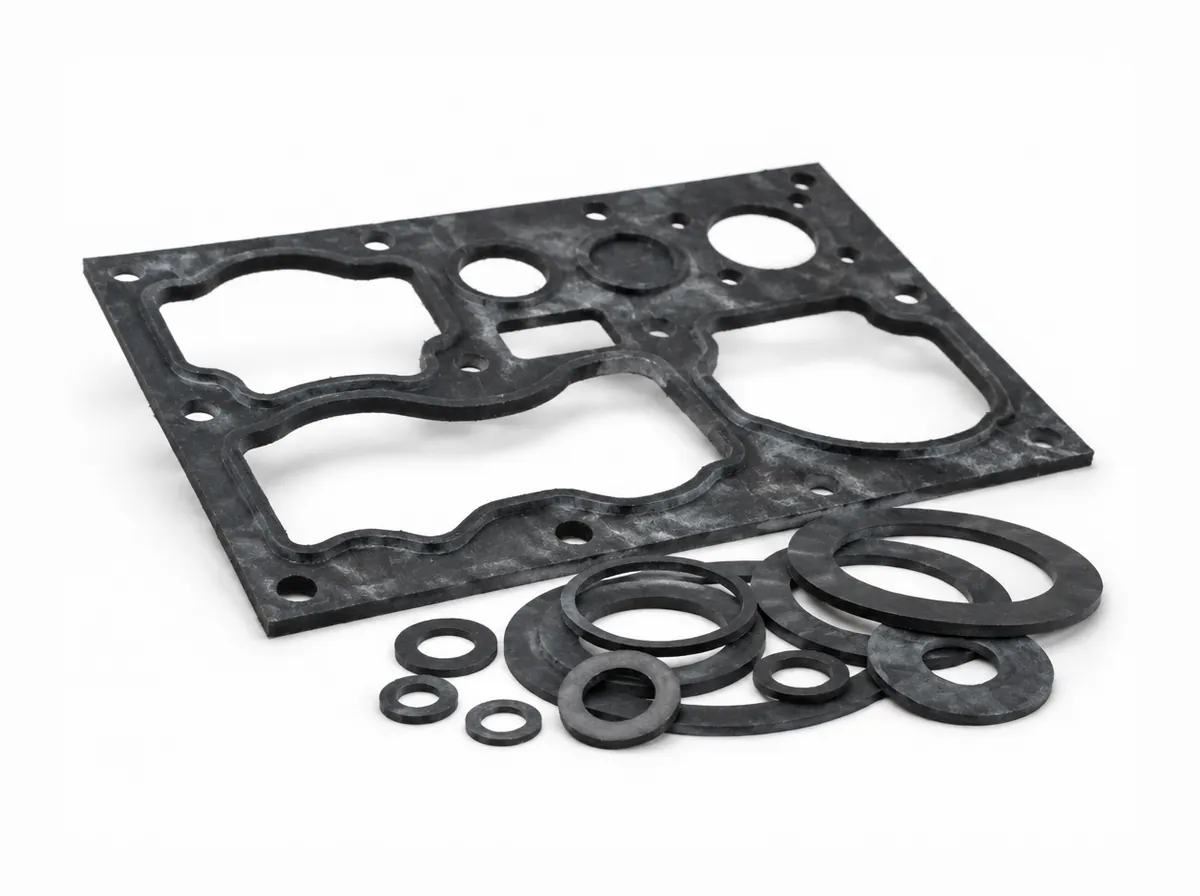
The DIN EN 1514 standard defines the requirements for flat seals used in flange connections. It covers various types of gasket, including:
-
DIN EN 1514-1: Flat seals made from soft materials, such as rubber or graphite.
-
DIN EN 1514-2: Metallic flat seals
Important requirements of this standard include:
-
Dimensional tolerances for standardised flange sizes.
-
Mechanical properties, such as pressure and temperature resistance.
-
Resistance to chemical attack by process media.
3. DIN EN 12560: Requirements for the petrochemical industry
DIN EN 12560 is a specific standard for flat seals used in petrochemical plants. It sets out the minimum requirements for seals that must withstand high pressures and temperatures as well as aggressive chemicals.
Key criteria include:
-
Pressure classes: Seals must be designed for pressures of up to PN 400 (400 bar).
-
Temperature ranges: Depending on the material, operating temperatures from -100 °C to over +600 °C are covered.
-
Media resistance: Chemicals such as sulphuric acid, methanol or hydrogen chloride must not attack the seals.
4. KTW-BWGL, DVGW and W270: Requirements for drinking water seals
Flat seals used in drinking water applications must comply with the strict rules of the KTW-BWGL guideline (plastics and drinking water) and DVGW W270 (microbiological testing). These standards ensure:
-
Hygienic safety: The seals must not release any harmful substances into the drinking water.
-
Resistance to disinfectants: Chlorine or ozone must not attack the material.
-
Long-term stability: The materials must remain stable for years, without becoming brittle or even cracking.
Typical materials for this application are EPDM and silicone, which are preferred because of their chemical stability.
5. FDA, BfR and EC 1935/2004: Flat seals for food
Flat seals in the food and beverage industry come into direct or indirect contact with food. Specific requirements apply here:
-
Regulation (EC) No 1935/2004: The European framework regulation for all materials in contact with food. Seals must not release any constituents in quantities that could endanger health, and must not alter taste or odour. Traceability and a declaration of conformity are also required.
-
BfR recommendations: In Germany, the German Federal Institute for Risk Assessment (BfR) Recommendation XXI (commodities based on natural and synthetic rubber) applies to rubber, and Recommendation XV to silicone. They specify permitted raw materials and migration limits.
-
FDA: For the US market, elastomers are governed by 21 CFR 177.2600 (rubber articles intended for repeated use), and PTFE by 21 CFR 177.1550.
Typical materials are light-coloured or white grades of EPDM, NBR and silicone. Which approval is needed depends on the food (aqueous, fatty, alcoholic), the temperature and the contact time.
6. UL94 and fire protection classes: flame-retardant flat seals
In electrical engineering, control cabinet construction and vehicle construction, flat seals often have to demonstrate defined burning behaviour:
-
UL94: The most widely used standard for the burning behaviour of plastics and elastomers. The classes range from HB (horizontal, slow burning) through V-2, V-1 and V-0 (vertical, self-extinguishing) to 5VB and 5VA. V-0 is the strictest of the V classes.
-
EN 45545-2: Fire protection requirements for materials in rail vehicles, divided into hazard levels HL1 to HL3.
-
DIN 4102 and EN 13501-1: Classification of the fire behaviour of construction products, for example for seals in building services.
CR (chloroprene) is inherently self-extinguishing. Silicone and EPDM are available in flame-retardant grades. The required class and material thickness should be defined early, because the UL94 classification always applies to a specific wall thickness.
7. ASME B16.21: Flat seals for piping systems
ASME B16.21 is an American standard that defines requirements for flat seals in piping systems. It is particularly relevant in international projects that use the ASME standard.
Key points of the standard:
-
Material requirements: The seals must meet ASME standards for pressure and temperature resistance.
-
Test methods: Strict tests for leak tightness and mechanical stability.
-
Marking: Every seal must be clearly marked to ensure traceability.
8. Testing and certification processes
Flat seals undergo a wide range of tests to ensure their conformity with the standards mentioned above. These include:
-
Pressure tests: Checking seal integrity under static and dynamic pressure.
-
Temperature tests: Determining the maximum operating temperatures and thermal ageing processes.
-
Chemical tests: Testing resistance to specific media such as acids, alkalis or solvents.
-
Leak tests: Ensuring tightness under various operating conditions.
9. The importance of conformity with standards
Compliance with standards is not only a mark of quality but also a legal necessity in many industries. It ensures:
-
Safety: Prevents leaks and system failures that could lead to damage.
-
Durability: Ensures a long service life of the seals, even under extreme conditions.
-
Legal compliance: Fulfilment of legal requirements and international standards.
-
Competitive advantage: Manufacturers who offer standard-compliant seals enjoy greater trust among customers.
Conclusion
Compliance with standards is indispensable for the quality and safety of flat seals. Whether DIN EN 1514 for flanges, KTW-BWGL and DVGW for drinking water, FDA, BfR and EC 1935/2004 for food, UL94 for fire protection or ASME B16.21 for international applications, every standard helps to ensure the performance and reliability of the seals. Manufacturers who rely on standard-compliant products secure not only the satisfaction of their customers but also the long-term operational safety of the systems they supply.